Monday, September 13, 2010

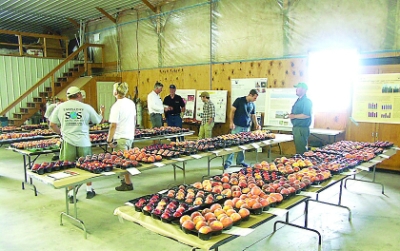
Growers look over samples of dozens of peach varieties at a fruit research open house held at Penn State's Fruit Research and Estensiion Center in Biglerville. 
     Peach growers left their tractors behind last week for a trip to Penn State's Research and Extension Center at Biglerville. Jerry Frecon, a Rutgers extension agent from Gloucester County, New Jersey, was on hand to share some of his knowledge and insights with the growers. He said Jersey's peach harvest is 10 days ahead of schedule. And he talked about the increasing role robotics is playing in the mechnization of fruit harvesting in general. Lancaster Farming staff writer Chris Torres attended the meeting and prepared a report for this week's print edition. Or you can read it online here: https://docs.google.com/viewer?url=http://lfg.live.mediaspanonline.com/assets/5051117/A01LFWE-
091110_1.pdf

     Check out the latest farm market news every week in Lancaster Farming.

Monday, August 30, 2010

If you pull something like this from
between your corn rows, keep it.
     Take care of your soil and it will take care of you. Especially around Hiddenite, North Carolina. Ninety-year-old Renn Adams and his siblings own a farm there where every once in awhile you might plow up an emerald or two. There was a time when the Adams family charged folks $3 a day to wield their shovels and take away any green goodies they might find. Terry Ledford, described in newspaper reports as a family partner, pulled an emerald out of the dirt a few years ago, and he could tell right away it was none of those run-of-the-mill emeralds, fit more for show-and-tell than a jewler's setting. Ledford's stone was big and dark and, well...big. After some cutting and polishing, processes that removed more than four-fifths of the stone's weight, the end product was a 65-carat gem about as big as a quarter and as heavy as a AA battery. It was cut to resemble a similarly sized emerald once owned by Catherine the Great, empress of Russia. That stone sold at Christies in New York this past April for a cool $1.65 million, which even if the Adamses and Ledford split it a few ways, is a sight better than 300-bushel corn. So, next time you're picking rocks, you might want to look down now and then to be sure it's not just a chunk of flint in your hand. AP writer Emery P. Dalesio wrote a gem of a story about the find, which you can read here: http://www.seattlepi.com/national/1110ap_us_carolina_emerald.html


Lyle Klingaman talks to visitors about
his high density grazing methods.
     High density grazing cuts feed costs and boosts profits for a Pa. cattleman with a herd of 20 Angus cows. By moving his animals from pasture to pasture, sometimes as often as twice a day, healthier grass, healthier cattle and a healthier bank account he told a group of about 25 curious farmers who turned out for a field day at his Mainville farm. The farmer, Lyle Klingaman, along with the Columbia County Extension Service and the USDA Natural Resources Conservation Service hosted the field day. Lancaster Farming correspondent Lisa Leighton covered the event and prepared a report which you can read in our current edition. Or check it out online at our website here: http://www.lancasterfarming.com/High-Density-Grazing-Taking-Smaller-Bite-of-Farmer-s-Profits


     If I ever get old, I want to be like Mary Maxwell. http://www.caregiverstress.com/2010/07/a-reminder-that-laughter-is-the-best-medicine/


Thursday, August 26, 2010

Infrared photo by Dick Wanner


     Visit this tree if you ever get to Penn State's Southeast Area Research Center near Landisville. This wounded locust is beautifully isolated and hard to miss.

    Speaking of Landisville, the center hosted a mini-field day this morning devoted to the subject of nitrogen management. How to keep it in your soil, how to get the most value from it, how to measure the effectiveness of your N application, whether in the form of manure, granules or liquid.  A surprise to me was that manure loses 20% its nitrogen in the first hour after it's spread on the surface. Also news to me was the value of aerial photography as a tool for nutrient management. There'll be a story about the event in the September 3 (September? Already?) edition of Lancaster Farming, both in print and online.

     Why I'll always be careful where I pitch my tent. Or maybe I'll just stay in the lodge. http://www.bing.com/videos/watch/video/brown-bear-attack/269tm7de
    

Wednesday, August 25, 2010

     American-style farming techniques are threatening to revolutionize the British dairy industry, and not everybody's happy about it. Nocton Dairies is seeking approval for an 8,100-cow facility near the village of Nocton in Lincolnshire. Nocton's owners say they will keep pollution out of their watershed, and they'll keep the cows clean and happy. (Britons are especially sensitive to animal comfort. PETA, the Humane League, et al are pretty much minor league players compared to British animal rights activists.) Nocton says they'll be adding 85 jobs to the local economy - which could use the jobs - and they'll be using manure digester technology to generate electricity to run the farm with enough left over to sell to the national grid. It would be the biggest of the UK's 13,500 dairy farmers, where the average herd numbers 114. Only 94 of the current dairy operations have more than 500 cows. There's a story in The Economist about the stir the plans are causing, and you can read it here: http://www.economist.com/node/16793059?story_id=16793059


     Using antibiotics to not just cure but to prevent livestock disease is a perennial hot button topic. at last week's Penn State Ag Progress Days, Lancaster Farming staff writer Chris Torres sat in on a session with Penn State Extension veterinarian David Wolfgang as he explained what he feels are the pluses and minuses - mostly pluses - of treating sick animals and also of treating animals with subtherapeutic doses to keep them from getting sick. You can read the report in our current print edition, or check it out at our new website, which is here: http://lfg.live.mediaspanonline.com/assets/4940567/A01LFWE-082110_1.pdf

     Hoops at the White House. (Not what you think.) Saw this first on our new website: http://www.youtube.com/watch?v=07vtMJgp0no

Tuesday, August 24, 2010

AP Photo/Kamran Jebreili
Camelicious Dairy camels await their turn
in the milking parlor in Dubai, Saudi Arabia.

     A California camel dairy made AgScene about a month ago, notable because the sale of camel milk in this country is illegal, but if it were legal would sell for around $200 a gallon or $1,720 a hundredweight. That is, until all the neighbors started buying their own bactrians and dromedaries. Which may be somewhere on the distant horizon. Last month, European Union health regulators approved the importation of powdered camel milk from the United Arab Emirates. Ulrich Wernery, a veterinarian who works in Dubai, has been touting camels and camel milk for a decade. In 2003, with the backing of Dubai's ruler, Sheik Mohammed bin Rashid Al Maktoum, Wernery started his Camelicious dairy enterprise, which today numbers 700 milking camels, producing 5,000 liters of milk per day, or about 105 cwt. Camelicious products, both in liquid and powdered form have been selling in the UAE for about the last four years and now, Wernery says, they're ready to expand into the 27-nation EU. And then maybe Asia and America. AP writer Brian Murphy paid a call on the Camelicious beauties. You can read his report here: http://www.star-telegram.com/2010/08/21/2417350/dubais-ruler-hopes-to-expand-popularity.html 


Lancaster Farming photo by Anne Harnish
Crowds found plenty to see and do at Penn State's Ag Progress Days.
     Lancaster Farming staffers spent much of last week at Penn State's Ag Progress Days in Rock Springs. The event never fails to entertain and educate. Food and Family Editor Anne Harnish spent a day there, trolling for story ideas and pointing her camera every which way. For the usual generous helping of recipes and more of Anne's Ag Progress Days' photos, see our current print edition, our check out our new web offering here: https://docs.google.com/viewer?url=http://lfg.live.mediaspanonline.com/assets/4940613/B03LFWE-082110_1.pdf


     No matter how famous this blog may make me, I will never submit to a Steven Colbert interview. 
http://www.colbertnation.com/the-colbert-report-videos/350636/august-17-2010/better-know-a-lobby---american-meat-institute

Monday, August 23, 2010

Recalled.
     Do you buy eggs? Do you buy them one at a time? Does half-a-billion eggs sound scary? It sounds like all the eggs in the world to me and then some. This morning on the Today Show, Matt Lauer said the current egg recall involved nearly half a billion eggs, "...that's 'Billion' with a 'B'," he stressed, implying that absolutely the eggs in your fridge must be poison. In my opinion, the news reports are accurate, but they are overstating the case.
     The odds of getting sick from eating eggs are small, but make no mistake - this is a serious health issue and it's a serious challenge for the egg industry. A few bad apples, from what I've read, have put not only their customers, but their industry in peril. Did I say bad apples? I should have said "dirty, rotten crooks." 
     I did some marketing work for an egg company a while back - a way while back, actually - at a time when the industry was struggling with S. enteriditis. I can tell you that the people I worked with had their hearts in the right place - it was food safety first and profits later. And I think they are the kind of people who dominate the egg industry. 
     Collectively, they and their colleagues produce about 215 million eggs a day, or more than a billion eggs every five days. That's "Billion" with a "B." Or to put it another way, a way that is more understandable to the people who buy eggs, 18 million dozen eggs a day. About 41.7 million dozen eggs have been recalled so far, which is less than three days of the total national production. Those eggs were linked to 1,300 cases of salmonellosis, a disease that can make you sick and miserable. Or it can kill you. 
     The FDA, the USDA and the CDC are working overtime to measure the danger and get it under control. The feds are looking for more staff, more money and more control to deal with and prevent future outbreaks of food-borne illness, and I hope they get it. 
     But I think the industry needs to crack down on its own bad actors. The locavore movement has gained momentum because consumers want to know where their food comes from and who's producing it. They would not want to deal with Jack DeCoster, who runs Wright County Eggs in Galt, Iowa, and is believed to be the man behind the salmonella outbreak. 
     He's the sixth-largest egg producer in the U.S., and has a history of paying fines for tainted product, pollution, and animal cruelty. His enterprise has also paid fines for sexual harassment of female employees. He's a bad egg, a black eye and a liability for the industry, yet restaurants, grocery chains and food manufacturers keep buying his product. 
     If locavore consumers can be educated, and/or self-educated enough to check out their food sources, it seems to me that businesses, large and small, who are paying thousands and millions of dollars a year for eggs can check out their suppliers. If you are one of those buyers and a guy like Jack DeCoster comes knocking on your door, just say "No." Get rid of his market and you get rid of him. 
     I believe government oversight is always going to be with us because there will always be bad actors in the marketplace. I also believe that a self-aware and self-regulated market can be much more than a mechanism for profit, and much more effective than all the government controls in the world. Honest people in a well-run industry can also be a tremendous force for good. 
     I've seen it happen.      

Friday, August 20, 2010

     Locavores are self-indulgent, self-defeating, dogmatic do-gooders who may or may not have jumped the sustainably raised organic-chub-fed shark. Whoa! Where did that come from? Was that Glenn Beck? A Sara Palin Rant? No, actually. The self-indulgent part came from Stepen Budiansky, an op-ed contributor to yesterday's New York Times and the author of a blog called liberalcurmudgeon.com. Budiansky, of Leesburg, Va., grows a lot of stuff in his backyard garden which is about as local as you can get. Just 42 steps from his back door and he's got a handful of spinach. He's annoyed that New Yorkers consider it a sin to buy a California tomato, but it's okay to buy one from a lavishly heated greenhouse in the Hudson Valley. He has no problem with the locavores' sentiments. He just wants them to get their math straight. He gives some examples, and you can read them here: http://www.nytimes.com/2010/08/20/opinion/20budiansky.html?th&emc=th. The jump-the-shark goodie came from here: http://jcarrot.org/has-locavore-jumped-the-sustainably-raised-organic-chub-fed-shark. The jcarrot.org blogger was astounded when he read in yet another New York Times story that a company in San Francisco will actually come to your house to plant and tend to your garden throughout the growing season. The writer comments that "locavore" was named Word of the Year for 2007 by the Oxford New American Dictionary. His pick for the next word of the year? "Lazyvore." 


Don McNutt, of the Lancaster
County Conservation
 District, addresses
the hearing in Rock Springs
.
     Can farmers dodge the EPA hammer? Matt Ehrhart, executive director of the Chesapeake Bay Foundation Pennsylvania office told a meeting Wednesday that his state's farmers have made tremendous strides in reducing the amounts of nitrogen and phosphorus entering the Chesapeake Bay watershed. He said the agency should not be treating every cleanup effort like a nail that needs to be hammered equally, and that agriculture has already taken more than its share of pounding. Pennsylvania ag sent a lot of its biggest guns to Ag Progress Days at Rock Springs for a joint hearing of the State House and Senate Agriculture and Rural Affairs committees. Ag Secretary Russell Redding testified on behalf of farmers, as did Penn State Dean of Agriculture Bruce McPheron. They were joined by other commentators. Lancaster Farming special sections editor Charlene Shupp Espenshade attended the hearing and wrote a report that will show up with your paper in the mailbox tomorrow. Or you can read it now in our online edition: http://www.lancasterfarming.com/APD-heading


     The thing that puzzles me is: Why are numbers 43 and 44 smiling? http://www.flixxy.com/presidents-morphing.htm