Saturday, November 20, 2010

     What do YOU think about carbon credit trading? If you're like most of the 90 people who responded to a Lancaster Farming on-line poll, you're not too optimistic. Just about 80 percent of the respondents said they don't think the concept is ever going to be profitable. Less than 15 percent think it will be and about 7 percent can't make up their minds. (These figures add up to more than 100 percent because I never was real good at math. English came hard, too.) You can keep tabs on our latest polls - and even participate if you're so inclined - by checking out our home page. You can see the carbon credit poll full graphic here: http://www.lancasterfarming.com/Polls/Results/Carbon-Credit-poll


Lancaster Farming's Melissa Mazzocca
interviews Ken Diller  for Ag Vids.
     Also new on the website this week is the first in a series of Ag Vids, brief videos featuring the businesses and the support staff behind that guy or gal who drives down your lane every so often to check on how you're doing and to find out if you're in the market for seed, parts or a new combine. The first Ag Vid focuses on the well-known Hoober Inc. enterprise. You can check it out here: http://www.lancasterfarming.com/video/agvids/agvid-hoober

     Jaindl Farms is to turkeys as the Susquehanna is to your average trout stream. Jaindl is big, marketing some 750,000 turkeys a year in the Northeast, including one special bird headed for the White House kitchen every Thanksgiving. The 12,000-acre Jaindal operation is by far the largest ag enterprise in Pennsylvania's Lehigh Valley. Lancaster Farming staff writer Chris Torres visited owner David Jaindl - a third-generation turkey man - to talk about the operation. One of the things he learned is that the whole enterprise started when Jaindl's grandfather bought five poults - for a buck apiece - from a neighbor in 1935. Check out the story in our current print addition or online at LancasterFarming.com.

     Ed Hall heard cows mooing one evening while he was eating dinner with his family in their South Philly row home. It was 1968, he was in the eighth grade, and he was fascinated with animals. He lept from the table, caught the end of a TV news report about cows and heard the words "...a high school with cows." That scrap of information led him to Philadelphia's Saul High School, from which he graduated in 1973, then to Penn State for an ag degree, back to Saul as a teacher, and today as a sales rep for a meat company. Today, Hall and his wife, Patti, own a 13-acre mini-farm a few miles from Philadelphia, and they grow, among other things, turkeys. Every year, they invite 40-50 friends and family to their place to prep the turkeys for everybody's Thanksgiving tables, and to bake pies. Lancaster Farming food and family features editor Anne Harnish talked to the Halls about their turkey tradition and prepared a report for our current edition.

Saturday, November 13, 2010

     Let's say you had an impulse to throw a pumpkin...oh, say, 500 feet down the line. You're not going to do that with your arm obviously, so you might want to confer with Dr. David Drummer and his physics students at Kutztown High School in Kutztown, Pa. The Doc and two of his students, senior Andrew Dietrich and junior Dustin Hoffman (No, not THAT Dustin Hoffman) built a trebuchet (TREB you shet) with the ability to hurl a pumpkin farther that you'd ever thought you'd want to see a pumpkin go. Their goal was to set a new world record at the annual Punkin Chunkin (PUNkin CHUNkin) contest in Bridgeville, Del. They didn't set a new world record, but their team, Stomach Virus, came in second with a toss of 653 feet, besting such teams as the fearsome Siege of Condor and the Wascaly Wabbits. There's a story about their efforts in the Kids Korner on page B10 or our November 13 edition. That's Dr. Drummer himself in the photo watching a test shot back in Kutztown.


Greengrow's co-manager Nina Berryman looks over
some of the CSA's late summer offerings
     Start with a two-acre patch of concrete, truck in some topsoil, and you've got a farm in downtown Philly. The patch of ground, site of a former steel mill, is home to a 400-member CSA (community supported agriculture) group called Greengrow. Lancaster Farming correspondent Kristen Devlin and reporter Michelle Kunjapu joined a recent tour of Greengrow and two other urban ag facilities in and around Philadelphia. They wrote about the experience for the Rural Ventures section in our current edition.
Jim Hershey addresses a no-till tour.
     No-till practices have taken root in Pennsylvania. Some 60 percent of the state's tillable acres are planted in no-till cover crops, reducing nutrient and sediment runoff and saving on fertilizer costs. But there's another reason for farmers to consider no-till practices, and that is the cash that might be generated with carbon credits. With cap-and-trade all but dead, there's still a chance that farmers could profit from the carbon captured in the soil with no-till, according to Jim Hershey, with the Pennsylvania No-till Alliance. Hershey hosted a field day on his Lancaster County farm recently to explain the benefits of the practice and the potential bonus from carbon credit training. Lancaster Farming staff writer Chris Torres was there and reported on the event in our November 13 edition.

Saturday, November 6, 2010

     Take it for granted, a few western Pennsylvania farmers are investing for the future with grain-drying equipment that cuts fuel costs. Jesse Powell, a former steelworker, left his job in a mill to work fulltime at a 2,000-acre grain operation. With the help of USDA grants - obtained with the help of a professional grant writer - he installed his new equipment in time for this year's harvest. Lancaster Farming correspondent Carol Ann Gregg called on Powell and a few others in the area to find out more about their new equipment and the grants that funded the ventures. Her story is on page one of our current edition.


     Manure injection is another process that's getting a lot of attention from farmers who want to preserve the soil nutrients in the inevitable byproduct of livestock farming. With surface application, much of manure's fertilizer value is lost to the air. At his annual cover crop field day, Lancaster County farmer Steve Groff invited LehmanAgService owner Steve Lehman to demonstrate his huge six-injector rig to the dozens of curious who turned out for the day. Lancaster Farming staff writer Chris Torres was there, and wrote a couple of reports for our November 6 edition.

     "You gonna horn in on me?" "No, I'm gonna horn in on you!" The George family - Dolly, Lloyd and Jared - see a lot of this kind of action on their Catawissa, Pa., farm this time of year, which is breeding season for deer. For the past dozen years or so the Georges been operating a 160-acre red deer farm that today is home to more than 450 of this elk-like species. They are prized for their lean meat and impressive antlers. English royalty were so protective of their private stock that at one time a commoner faced a death penalty for killing a red deer. Lancaster Farming correspondent Sue Bowman paid a recent visit to the Georges' Rolling Hills Red Deer Farm and prepared a report for the food and family section of our current edition.

     Cutie-pie kitties on this old Lotto game could be worth $40 to $50 dollars at auction, according to a story by Lancaster Farming correspondent Linda Sarubin. The story in this week's edition - just after the Mailbox Markets section - delves into the history of board games, and how they became popular during the Great Depression, when people stayed home because they couldn't afford to go out. Hmmm...anybody for a game of Monopoly?

Saturday, October 30, 2010

 
Ann Adams operating a lightweight wheel hoe.
     A woman's touch...isn't the same as a man's touch. Liz Brensinger, with a master's degree in nursing, and her friend Ann Adams, whose master's is in public health, had a wealth of professional knowledge about the physiological differences between men and women. When they started to grow vegetables for Adams' son, a gourmet chef, they went looking for the best farm tools they could find that were designed for use by women and they found...none. Zip. Zero. Nada. So they designed their own. And started a business. Lancaster Farming Regional Editor Margaret Gates interviewed the partners and wrote about them for our October 30 edition. It's in the food and family features section.
 
Some of the research apparatus
at the Stroud Water Research Center.

     After more than 20 years of study into the effect of trees on streams, scientists at the Stroud Water Research Center in Avondale, Pa., can say that trees play an important role in maintaining a healthy and stable ecosystem. A riparian (fancy word for "streambank") buffer zone of 100 feet or so, whether it's covered with grass or trees, can help reduce erosion, sedimentation, and nutrient flow into streams. But trees work best, a fact staff writer Chris Torres learned on a recent tour of the Stroud Center which was sponsored by a couple of environmental groups. His report starts on page one of our current edition.

     And now for a pop quiz...Why did 18th century Felix de Azara think popcorn tasted like hair? And what kind of guy was Azara, anyway, and what's the real reason he went to Paraguay? You'l find a whole page of fascinating popcorn history, science and lore on page B10 of this week's Lancaster Farming.
  
Ron Bingaman shows his granddaughter
Avery a restored IH tractor.

     The thing about tractor people is some like red ones, some favor green, or yellow, or blue. But if a John Deere guy needed to borrow a wrench from an IH guy, the JD guy would have his wrench, with maybe a sly comment or two about why he needed a wrench in the first place. Wouldn't it be nice if we could all get along like that? Using our differences to build bridges instead of walls? That's the way the tractor community operates. You can get a look at the IH side of that community in Millville, Pa., where the local chapter of the International Harvesters Collector Club bought an IH dealership that it hopes to turn into a museum. Stay tuned to the IH collectors website (nationalihcollectors.com) for the grand opening in a year or so. And if you do make it to the museum, you might want to leave that green cap - you know the one we mean - in the truck. Lancaster Farming correspondent Lisa Z. Leighton paid a visit to the Millville IH folks when they celebrated the purchase of the dealership. Her report is on page B23 of this week's edition.


Saturday, October 23, 2010

     Check out these news items and many more in our October 23 print edition, or online at lancasterfarming.com.


Bobby Prigel at his on-farm creamery.

     Here's a new item to add to your list of farming hazards - lawsuits. Bobby Prigel, a fourth-generation dairyman from Glen Arm, Maryland, tends to a herd of 180 Jerseys. He and his family decided a few years ago that they'd like to develop a creamery and ice cream business on a patch of their preserved farmland. After they secured all the required permits, the lawsuits began. Was the operation permitted on preserved land? Did state health officials properly evaluate the creamery before issuing a license? Is their roadside stand legal? Prigel figures the family's $200,00-and-still-growing legal bill has paid off in publicity. Some 400 people showed up for opening day in September. Lancaster Farming reporter Chris Torres called on the Prigels to see how they're making out.


     Chris Torres also attended a recent meeting in Lancaster, Pa., where the federal Environmental Protection Agency told an audience that included farmers and officials from the Pennsylvania Department of Environmental Protection that their proposed steps to limit the state's flow of pollution to the Chesapeake Bay were not enough. It was, nevertheless, a quiet meeting, according to Torres.

     Pennsylvania lost 14 percent of its dairy farmers between 2006 and 2009, according to a page one report byJames Haggerty, who writes for the Scranton Times Tribune. That means that about one in every seven dairy families emptied their bulk tanks for good in just a three-year period. The flight was thanks mostly, but not entirely, to a drop in the on-farm milk price from $20.26 in November, 2008, to $12.90 in June, 2009.

     October, you probably already know, is National Pork Month. This week's Home on the Range page features a recipe for happy pork chops, and an easy pulled pork recipe that goes into the slow cooker. And eight other recipes sure to tempt the palate.

     Writing from Moneta, Virginia, Lancaster Farming correspondent Jenneifer Merritt shares her own experience with bringing farmers, parents and school administrators together for a farm-to-school program. She was eager to see her sons, both students at Moneta Elementary, and their classmates eating cafeteria food grown on local farms. The good thing about local food is that it's fresh and flavorful. And, unlike some other cafeteria fare, you can always tell what it is.


Sunday, October 17, 2010

     A hearing room packed with raw milk producers and a few of their customers listened to Pennsylvania Department of Agriculture officials propose an overhaul of the state’s milk regulations on Thursday, Oct. 7.
Five PDA officials presented their case to the Pennsylvania Independent Regulatory Review Commission, a five-member group charged with ensuring that new regulations are both legal and effective. In the end, after nearly 4-and-a-half hours of testimony and questions, the IRRC commissioners voted 3-2 to disapprove the PDA’s proposed rule change.
     Commission Chairman Arthur Coccodrilli, a businessman from Peckville, asked the department to try again. The proposed regulations are designed to bring the commonwealth’s rules in sync with those of the majority of other states, a move that one PDA official said was 25 years overdue. Read more at http://www.lancasterfarming.com/1016-Milk-hearing


     The director of the only tractor test lab in the Western Hemisphere will be talking tractor testing at Binkley and Hurst’s annual Customer Classic next 
month. Roger Hoy, director of the Nebraska Tractor Test Laboratory, will be making two one-hour presentations each day of the Customer Classic, 
which is being held Nov. 17 and 18 from 8:30 a.m. to 3 p.m. at the dealership in Lititz, Pa.
     The test lab is the country’s only officially designated tractor testing station. Tractors are tested according to the codes of the Organization for Economic Co-operation and Development. Twenty-nine other countries adhere to these codes. 
     The lab was started in 1920 after a disgruntled Nebraska farmer found that three tractors he bought did not perform as advertised. According to Hoy, the farmer’s efforts led to the enactment of a state law requiring all tractors be tested on their performance before being sold. Early testing focused on the tractor competing against horse-drawn implements. Things have changed since then. Lancaster Farming staff writer Chris Torres prepared a report on the upcoming event for our print edition or the website at http://www.lancasterfarming.com/Tractor-Test-Lab-to-be-Featured-at-Dealer-Event


     Members of the Berks County Livestock Clubs exhibited and sold their 4-H projects at the 2010 Annual Roundup at the Reading Fairgrounds the end 
of September. The sale featured 104 project animals grossed $77,225. For more details and photos check out our print edition or online at 
lancasterfarming.com.  http://www.lancasterfarming.com/Livestock-Sale-Grosses-More-Than--77-000-for-Berks-4-H-Youth


     When Russell Shaw started a small apple orchard 10 feet north of the Mason-Dixon Line in 1909, he had no idea it would still be there 100 years in 
the future. The story of how that initial enterprise grew into a century-old agricultural enterprise is recounted in our current edition by Lancaster Farming correspondent Linda Sarubin. To read the story and see the photos, click here: http://www.lancasterfarming.com/Family-Roots-Run-Deep-at-Shaw-Orchards


     Two Pennsylvania cows were named grand champions of their breed recently at the World Dairy Expo in Madison, Wis. Tex-Star Othello Peri, exhibited by Springville Farm and Fisher of New Enterprise, Pa., took grand champion and best uddered at the International Milking Shorthorn Show and also won the aged cow class. Hard Core Farms of New Enterprise was named premier breeder and premier exhibitor at the Milking Shorthorn show. For the story and photos, see http://www.lancasterfarming.com/Pa--Cows-Take-Honors-at-World-Dairy-Expo

Saturday, October 9, 2010

     Would you like to supersize that? These young french-fry cutters sliced their way through a ton of poataoes during a recent fund-raising auction for the Clinic for Special Children in Strasburg, Pa. The non-profit insitution focuses on children with metabolic disorders, and gets a funding boost from its annual auction. This year 1,700 registered bidders competed for, among many other items, 79 donated quilts. Lancaster Farming reporter Michelle Kunjapu attended the auction, ate a few fries and took this photo, which appears in our current edition.


     All dried up...that's a good thing. Food and Family Features Editor Anne Harnish spent a few hours recently in the kitchen of Janice Bowermaster, who has been putting up dried fruits and vegetables for more than 40 years. She's done everything from apples to zucchinis (although she's not quite happy with her zucchini efforts) until, has won blue ribbons at local fairs and state competitions, and plans to keep her dehydrators running for the foreseeable future. Anne's story on the master dehydrator is in this week's Section B.
     
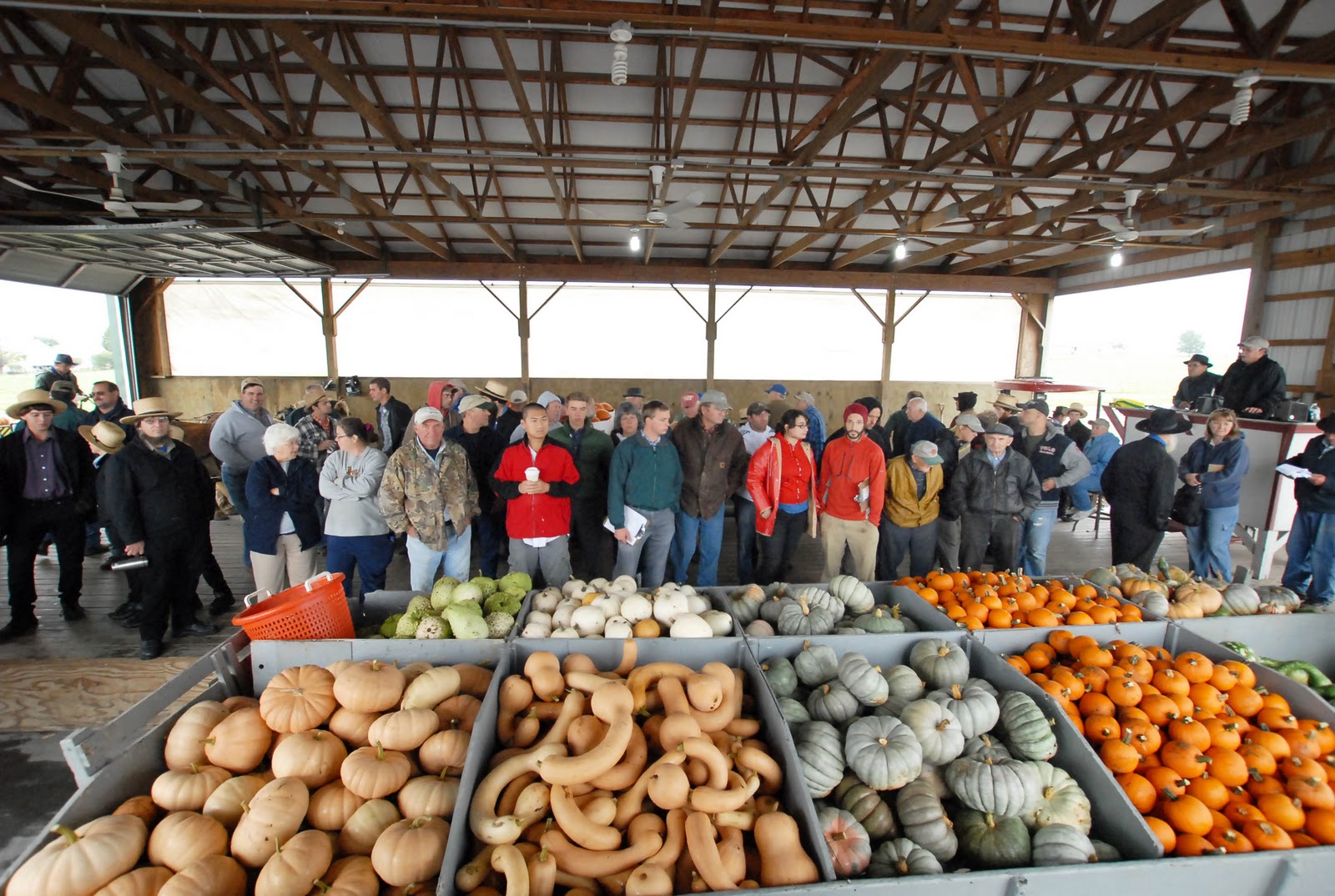
     A gourd-ious time of year. Do our headline writers have a sense of humor? What do you think. Check out the photo of gourds and men on page one, then go to the Home on the Range feature for wealth of seasonally appropriate squash and pumpkin recipes.
     
     Also worth reading: Chris Torres' story on the impact of funding cuts on Pennsylvania's animal lab system; Andrew Jenner's take on an EPA TMDL hearing at James Madison University; and Charlene Shupp's story on the poultry industry's search for alternatives to antibiotics. See our print edition, or go to http://lancasterfarming.com.